The Executive Reality: Navigating the Legislative Threat Matrix
For Operations Directors governing tier-one infrastructure in Victoria, the operational landscape of 2026 is defined by a ruthless convergence: the demand for rapid, high-yield project delivery intersecting with the most aggressive regulatory enforcement environment in the state’s history. Safety governance can no longer operate as a siloed administrative function; it is an existential corporate vulnerability.
The data is unequivocal. In 2025 alone, unsafe employers incurred $17,391,325 in penalties across 137 completed WorkSafe prosecutions and enforceable undertakings. The construction sector bore the absolute brunt of this regulatory offensive. Most critically, the legal precedent has been set with a record-breaking $3 million corporate fine for a workplace manslaughter conviction. When individual directors face up to 25 years in prison, relying on static, paper-heavy compliance artifacts is not just functionally obsolete, it is a breach of fiduciary duty.
$17M+
In total penalties for unsafe work in 2025 alone, demonstrating an aggressive enforcement stance.
To insulate the board and protect the workforce, health and safety strategy must evolve from reactive enforcement into predictive systems engineering. This case study outlines the architectural framework required to operationalize two of the most significant legislative threats facing modern mega-projects: the anticipated reduction of the respirable crystalline silica standard, and the strict mandates of the Occupational Health and Safety (Psychological Health) Regulations 2025.
The Methodology: Systems-Thinking in Deep Excavation
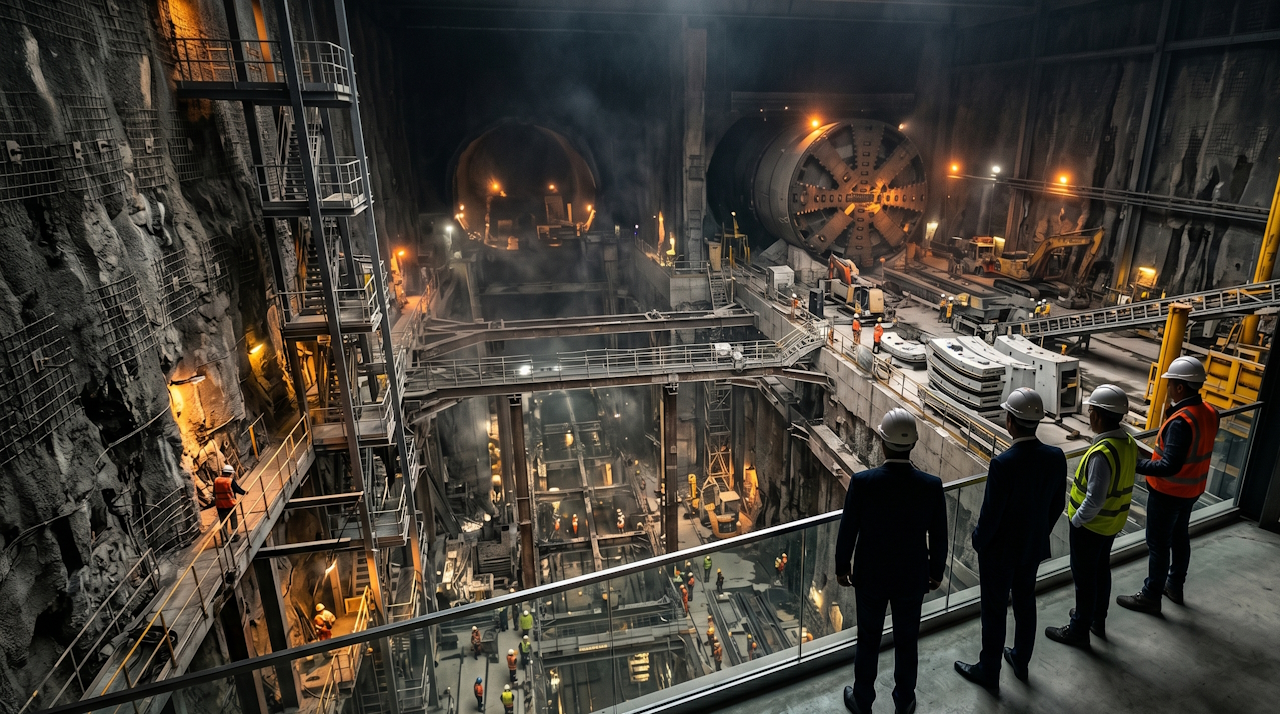
Traditional safety management (Safety-I) operates on the assumption that human error is the primary cause of incidents, and that behavior can be entirely constrained through rigid procedural adherence. However, in hyper-complex, dynamic environments, such as the deep tunnel boring required for the $30 billion to $34.5 billion Suburban Rail Loop (SRL), this framework shatters.
When encountering unexpected geological faults, equipment malfunctions, or extreme fatigue, frontline crews inevitably deviate from standard operating procedures to maintain production. Under a traditional model, this gap between “Work-as-Imagined” (the idealized boardroom procedure) and “Work-as-Done” (the gritty frontline reality) creates a massive, unquantified blind spot.
By applying Human and Organizational Performance (HOP) and Safety-II principles, elite executive governance acknowledges that human adaptability is not a liability to be controlled, but a systemic asset to be harnessed. Instead of punishing operational deviations via retributive justice, the executive mandate is to engineer resilience into the work environment. We do not demand that workers simply “try harder” to navigate hostile conditions; we redesign the conditions themselves to absorb human variability.
The Silica Strategy: Engineering the 0.025 mg/m³ Response
The regulatory frontier for crystalline silica management has moved far beyond the fundamental directive to “wear a mask.” With Safe Work Australia proposing a drastic reduction of the Workplace Exposure Standard (WES) to 0.025 mg/m³, an executive strategy requires a highly engineered, holistic defense.
In a deep-excavation or tunneling environment, relying on Personal Protective Equipment (PPE) as a primary control is a systemic failure. The executive response mandates the integration of granular, task-based silica risk assessments directly into the overarching Construction Environmental Management Plan (CEMP).
This is operationalized through three critical vectors:
- Predictive Profiling: Establishing baseline exposure profiles before ground is broken, treating respirable silica as a critical environmental contaminant rather than a localized site hazard.
- Atmospheric Intelligence: Deploying continuous, real-time atmospheric monitoring inside enclosed tunneling environments, establishing hard data triggers that automatically halt work when exposure ceilings are threatened.
- Source Elimination: Future-proofing operations by mandating advanced engineering controls at the procurement phase. This includes outfitting all heavy machinery with sealed, positive-pressure plant cabins, mandating on-tool extraction, and utilizing HEPA-filtered local exhaust ventilation (LEV) to capture the hazard at its point of generation.
The Psychosocial Strategy: Structural Mitigation over Secondary Intervention
The Occupational Health and Safety (Psychological Health) Regulations 2025 fundamentally dismantled the traditional corporate approach to mental health. Providing “resilience training” or secondary interventions like Employee Assistance Programs (EAP) is no longer legally defensible as a primary strategy. The legislation explicitly states that information, instruction, or training cannot be relied upon exclusively to manage risk.
The law demands a proactive hierarchy of controls: employers must eliminate psychosocial risks, and if that is not reasonably practicable, reduce them by systematically altering the management of work, plant, systems of work, work design, or the workplace environment.
For fatigue-intensive operations, structural mitigation is the only compliant pathway:
- Work Design & Fatigue Forecasting: We do not ask deep-excavation crews to manage their own fatigue. We intervene at the work design phase, utilizing resonance mapping to optimize shift rotations and physically sequence high-cognitive-load tasks away from circadian troughs.
- Organizational Justice: Poor organizational justice and lack of support are primary psychosocial hazards. By hard-wiring a Restorative Just Culture into the incident investigation framework, we eliminate the trauma of retributive blame. Accountability is redefined as systems-repair, ensuring workers have the psychological safety required to report the leading indicators of failure without fear of termination.
The Executive Close: Translating Safety into Commercial ROI
Elite health and safety governance does not operate in a commercial vacuum. By bridging the compliance void through systems-thinking, the operationalization of these strategies directly translates into quantifiable financial outcomes.
Proactive structural mitigation of psychosocial hazards prevents the compounding costs of high turnover, unplanned absenteeism, and costly psychological injury claims. Similarly, engineering out crystalline silica at the source insulates the organization from catastrophic regulatory shutdowns, multi-million dollar fines, and project delays.
$3M+
Maximum corporate fine already established for industrial manslaughter, making regulatory exposure an existential risk.
Ultimately, shifting from static compliance to systemic resilience elevates safety from a localized cost center to a critical driver of operational yield. It secures the supply chain, guarantees production timelines, and provides the board of directors with the absolute assurance required to execute multi-billion dollar mandates in a highly volatile era.
References & Literature Synthesized
- WorkSafe Victoria (2026). More than $17 Million in Penalties for Unsafe Work in 2025. State Government of Victoria.
- Victorian Parliament (2019). Occupational Health and Safety Act 2004 (Vic), Section 39G: Workplace Manslaughter. (Workplace Safety Legislation Amendment Bill 2019).
- Court of Appeal (Victoria) (2025). Director of Public Prosecutions v LH Holding Management Pty Ltd VSCA. (First completed prosecution and subsequent $3M maximum penalty appeal).
- Safe Work Australia (2025). Model Code of Practice: Managing Risks of Respirable Crystalline Silica in the Workplace (August 2025 Edition).
- Victorian Government (2025). Occupational Health and Safety (Psychological Health) Regulations 2025 (Vic) (Commenced 1 December 2025).
- WorkSafe Victoria (2025). Compliance Code: Psychological Health (Edition 1, September 2025).
- Hollnagel, E. (2018). Safety-II in Practice: Developing the Resilience Potentials. Routledge, London.
- Suburban Rail Loop Authority (2025). SRLA Annual Report 2024-25. State Government of Victoria.
- Dekker, S. (2018). The End of Heaven: Disaster and Suffering in a Socially Fragmented World. Routledge, London.