The Executive Abstract
The prevailing architecture of industrial risk management relies upon a fundamental illusion of centralized control. For decades, high-risk operational environments have functioned under the assumption that safety is strictly defined by the absence of negative outcomes, a state superficially achieved by constraining human behaviour through rigid procedural compliance. This model, widely recognized within contemporary systems engineering and organizational psychology as Safety-I, inherently assumes that Work-as-Imagined perfectly mirrors Work-as-Done.
When highly regulated industrial environments, such as complex telecommunications infrastructure decommissioning and heavy structural scaffolding, encounter unpredictable variables, standard operating procedures inevitably fail. Under the advanced, systems-thinking paradigm of Safety-II, human adaptability is rightly recognized as the ultimate safeguard and the primary driver of operational success.
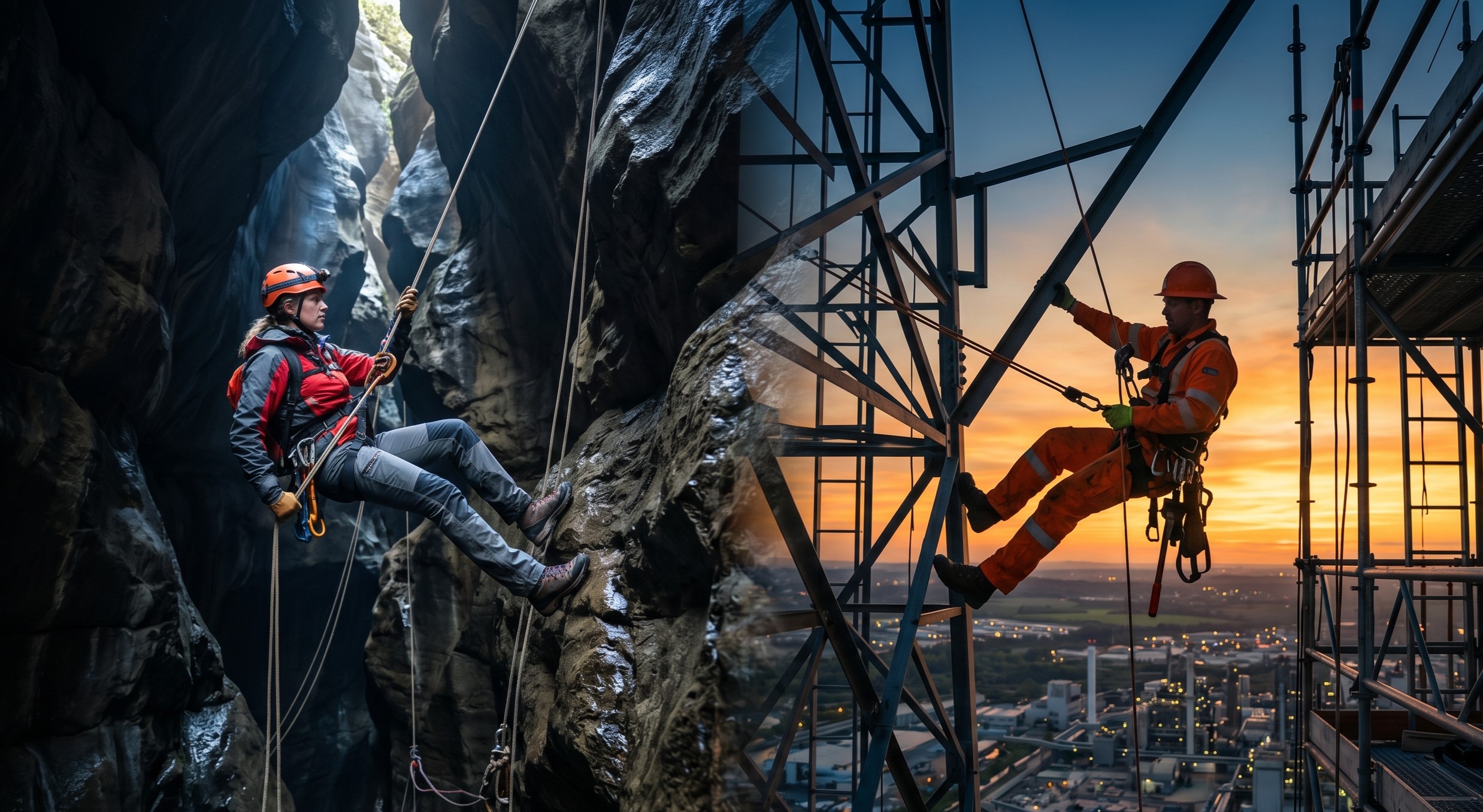
This paper synthesizes two distinctly different high-risk domains: the unstructured, extreme environments of wilderness canyoning, and the heavily regulated, fatigue-intensive operations of industrial decommissioning. Rejecting reactive lagging indicators and administrative bloat, this analysis strictly applies Erik Hollnagel’s Safety-II concepts and Sidney Dekker’s principles of Restorative Just Culture to engineer deliberate operational elasticity.
The Data Crossover: Wilderness vs. Industrial Resilience
To genuinely understand the necessity of cross-pollinating extreme wilderness adaptability with industrial operations, one must dissect the failure states inherent in highly regulated environments.
When fatigue sets in, whether at the bottom of a subterranean cave network or at the top of an incomplete scaffold, human operators fall victim to the exact same heuristic traps (Familiarity, Acceptance, Consistency, and Expert Halo). However, wilderness teams survive because they strip away centralized control in favor of decentralized, guided adaptability.
Here is the direct operational translation of those survival mechanics into the industrial sector:
1. Anticipating Systemic Friction
- The Wilderness Analogue (Route Profiling): Expedition cavers meticulously anticipate subterranean bottlenecks and acute hypothermia risks long before entering the system, fundamentally understanding how the hostile environment will progressively degrade their physical state.
- The Industrial Application (Resonance Mapping): Utilizing the Functional Resonance Analysis Method (FRAM) to map out exactly where the physical demands of telecommunications decommissioning will exceed human cognitive limits (e.g., scheduling heavy lifting away from circadian troughs).
2. Monitoring Work-as-Done (WAD)
- The Wilderness Analogue (Heuristic Peer Observation): Wilderness teams actively and continuously monitor each other for cognitive biases. If the lead climber exhibits the “Expert Halo” trap, the team possesses the psychological safety to call it out immediately.
- The Industrial Application (Behavioral Baselines): Scaffolding crews actively monitor deviations in their peers’ communication patterns and motor functions as leading indicators of severe fatigue, actively ignoring the Safety-I assumption that “the written procedure alone will keep them safe.”
3. Responding with Decentralized Execution
- The Wilderness Analogue (Survival Autonomy): When a slot canyon suddenly flash floods, the team immediately abandons the pre-planned map and relies entirely on localized decision-making to find high ground, unconstrained by external authority.
- The Industrial Application (Edge Authority): When a decommissioning crew identifies unexpected hazardous materials or structural degradation, they autonomously halt or re-sequence work immediately without waiting for off-site managerial approval.
4. Learning via Systemic Healing
- The Wilderness Analogue (Mental Model Updating): After a near-miss rockfall, the team discusses the environmental cues that were missed without assigning blame, utilizing the data strictly to update their collective mental model.
- The Industrial Application (Restorative Integration): Following a critical structural deviation, the organization focuses entirely on the needs of the first and second victims, altering the systemic architecture rather than isolating and punishing the worker.
The Predictive Resilience Matrix
Utilizing Erik Hollnagel’s deeply researched four potentials of resilience as its architectural foundation, this framework translates the fluid survival mechanics of an expeditionary crew into a highly structured, four-quadrant operational matrix designed specifically for high-risk, fatigue-intensive industrial environments.
Psychosocial & Fatigue Forecasting
Moving beyond historical accident data to actively predict points of systemic friction and cognitive degradation before they manifest, utilizing Resonance Mapping to sequence physically demanding lifts away from circadian troughs.
Work-as-Done (WAD) Calibration
The continuous, unfiltered assessment of actual work conditions versus idealized boardroom procedures. Frontline workers observe operational 'rubs' as neutral data points rather than reportable performance failures.
Decentralized Execution
The explicit authority to adjust work parameters immediately in response to changing physiological conditions, implicitly trusting decisions made at the 'sharp end' without bureaucratic sign-off.
Systemic Healing & Just Culture
Extracting highly functional data from both successes and failures without activating retributive justice. Redefining accountability as taking active responsibility for improving the system and repairing harm.
The Implementation Protocol
The true integration of the Predictive Resilience Matrix into active, high-risk operations cannot be achieved through the mere introduction of more administrative artifacts. The following Implementation Protocol outlines three highly specific, hard-wired operational changes.
Protocol 1: Decentralised “Edge” Authority for Fatigue Intervention
In traditional industrial hierarchies, actively altering a daily work schedule requires navigating a multi-tiered chain-of-command. To accurately replicate the rapid survival mechanics of a wilderness expedition, decision-making authority must be explicitly pushed to the “edge.”
Shift
Replacing the punitive "Stop Work Authority" with the "Adaptive Pause", normalizing the act of stopping work to reassess conditions as a standard part of the daily workflow.
- Elimination of the Approval Chain: The SOP is structurally rewritten to grant the localized crew leader the definitive authority to alter task sequencing (e.g., shifting heavy baseplate work to the early morning) without consulting off-site management.
- The “Adaptive Pause”: Normalizing proactive risk management without the threat of reprisal.
Protocol 2: Work-as-Done (WAD) Realignment Briefings
The traditional pre-shift “Toolbox Talk” functions almost entirely as a unidirectional transfer of Work-as-Imagined from management to the frontline. This protocol permanently abolishes it.
- Neutral Linguistics: Terms carrying retributive weight such as “violation” or “non-compliance” are structurally banned. They are systematically replaced with neutral, systems-focused terminology such as “adaptation” and “operational friction.”
- The “Rubs” Analysis: Crews are required to openly discuss the specific tasks from the previous shift where the procedure was impossible or dangerous to execute exactly as written.
Protocol 3: Restorative Investigation Integration
A traditional retributive response drives all vital, systemic information underground. Protocol 3 permanently dismantles the retributive investigation process and replaces it with a restorative inquiry explicitly aimed at repairing harm and driving profound systemic healing.
- Second Victim Acknowledgment: Immediate psychological first aid is hard-wired into the post-incident response, formally recognizing the profound psychological trauma associated with catastrophic near-misses.
- Restorative Inquiries over Disciplinary Boards: The primary, mandated questions of the inquiry are not “What rule was broken and who broke it?” but rather, “Who is hurt, what do they specifically need to heal, and whose structural obligation is it to meet that need?”
The Path Forward
The data across these domains points to a clear reality: when crews are subjected to severe fatigue, rigid procedures do not prevent failure, they precipitate it.
By deliberately integrating wilderness survival mechanics into industrial operations, filtered strictly through the advanced frameworks of Safety-II and Restorative Just Culture, organizations can engineer true, enduring operational elasticity. In executing this transformation, they successfully unlock the adaptive edge, permanently transforming their human workforce from a perceived operational vulnerability into their most robust, intelligent, and resilient systemic asset.
References & Literature Synthesized
- Alonso-Barajas, A. (2005). Human error and decision making in extreme environments: The canyoning paradigm. Safety Science.
- Brewer, C. (2024). Decentralized Authority in High-Reliability Organizations. Journal of Operational Risk.
- Comcare (2024). Psychosocial Hazards and Fatigue Management Guidelines.
- Cowart, M. et al. (2014). Cognitive pacing and heuristic trapping in expedition caving. Journal of Applied Psychology.
- Dekker, S. (2017). The Field Guide to Understanding ‘Human Error’. CRC Press.
- Dekker, S. (2023). Just Culture: Restoring Trust and Accountability in Your Organization. CRC Press.
- Dekker, S. & Breakey, H. (2016). ‘Just culture’: Improving safety by achieving substantive, procedural and restorative justice. Safety Science.
- Duchek, S. (2020). Organizational resilience: a capability-based conceptualization. Business Research.
- Hollnagel, E. (2012). FRAM: the Functional Resonance Analysis Method. Ashgate.
- Hollnagel, E. (2017). Safety-II in Practice: Developing the Resilience Potentials. Routledge.
- McCammon, I. (2002). Evidence of heuristic traps in recreational avalanche accidents.
- SafeWork Australia (2024). Managing psychosocial hazards at work Code of Practice.
- SafeWork Australia (2025). Managing the risk of fatigue at work.
- SafeWork NSW (2023). Legal obligations and documentation of risk (Clyde & Co Interpretation).
- Sexton, J. B. (2004). Shared situational awareness in high-risk environments.
- Younes, R. (2020). Human factors in offshore decommissioning: The waste mindset. Safety Science.
- Yusoff, M. et al. (2024). Qualitative exploration of tubular scaffold erection using the Fuzzy Delphi Method. Journal of Construction Engineering.